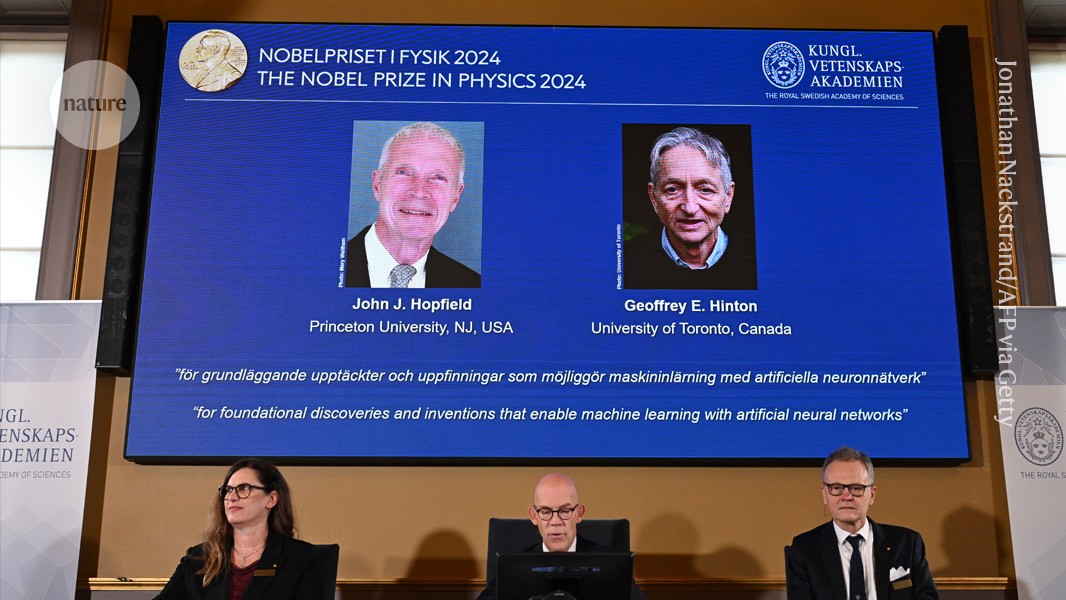
How machine learning is reshaping our world: the impact of Hopfield and Hinton
The data revolution has paved the way for machine learning, a transformative technology poised to revolutionize our approach to global challenges. This year’s Nobel Prize in Physics honored John Hopfield and Geoffrey Hinton, pioneers of artificial neural networks, whose innovations are transforming sectors such as healthcare and education, and streamlining complex systems across diverse industries.
Revitalizing neural networks: the legacies of Hopfield and Hinton
John Hopfield, a renowned physicist at Princeton University, first introduced the Hopfield network in the 1980s—an innovative type of recurrent neural network designed to store and retrieve patterns using an energetic minimization approach. This concept, based on statistical physics, works by forming stable configurations among interconnected nodes, thus enabling functions like image recognition and effective data storage. This groundbreaking invention paved the way for future algorithms crucial for parsing and interpreting vast amounts of information.
Geoffrey Hinton, equally groundbreaking in his research at the University of Toronto, expanded on Hopfield’s foundational concepts through his development of the Boltzmann machine. This evolution refined the learning process within neural networks by leveraging layered training methods with multiple Boltzmann machines, significantly enhancing accuracy in pattern recognition and classification capabilities. The fusion of his insights and methods has played a key role in improving technologies that drive image recognition software, recommendation engines, and natural language processing applications.
Bridging challenges through machine learning
The combined work of Hopfield and Hinton underscores the power of machine learning to tackle global challenges. From healthcare to finance, their neural networks have evolved into indispensable tools for addressing complex problems. Notably, significant advancements in medical diagnostics have stemmed from their work, enabling AI tools to assist healthcare professionals in early disease detection and developing tailored treatment plans for patients. As seen in the findings by Winberg F. et al. (Ching, Travers et al. 2018), such technologies not only foster improved quality of life but potentially save millions by ensuring timely medical interventions, especially crucial amid global health crises.
Long-term benefits and ethical considerations
As we explore the long-term implications of these discoveries, we notice the tremendous impact on fields like education and climate science. Emerging neural network models promise unprecedented efficiencies as they integrate into aspects of infrastructure management and environmental monitoring. Retail systems, now increasingly relying on advanced recommendation engines, streamline consumer experiences and dramatically enhance supply chain management.
However, while the prospects are exciting, we must critically address the ethical implications that arise when deploying machine learning. Challenges such as inherent biases in data, privacy concerns, and job displacement prompted by automation underscore our obligation to establish accountability in technological deployments—ensuring fair practices as we implement these powerful tools in service of society.
A transformative future
The importance of Hopfield and Hinton’s groundbreaking discoveries is being felt more than ever as we further immerse ourselves in the digital age. Their work ensures that machine learning systems are poised to sift through vast data landscapes, refining decision-making processes across various sectors efficiently.
As we pursue deeper understanding and actionable strategies for tackling pressing issues ranging from climate change to social inequities and healthcare challenges, the foundations laid by these pioneers promise a brighter future. As we further our efforts towards leveraging these technologies for the common good, we must uphold a firm commitment to enhancing quality and resilience within our communities worldwide.
The path ahead is surely full of opportunities and challenges, yet it remains promising; thanks to John Hopfield and Geoffrey Hinton, we are moving rapidly toward horizons where innovations pave the way for equitable advancements across borders.
By celebrating their achievements, we honor not only their legacies but also the paths they forge towards a more interconnected world driven by groundbreaking ideas and innovations focused on the enhancement of well-being.
 Elizabeth Gibney